Things You Wanna Know!
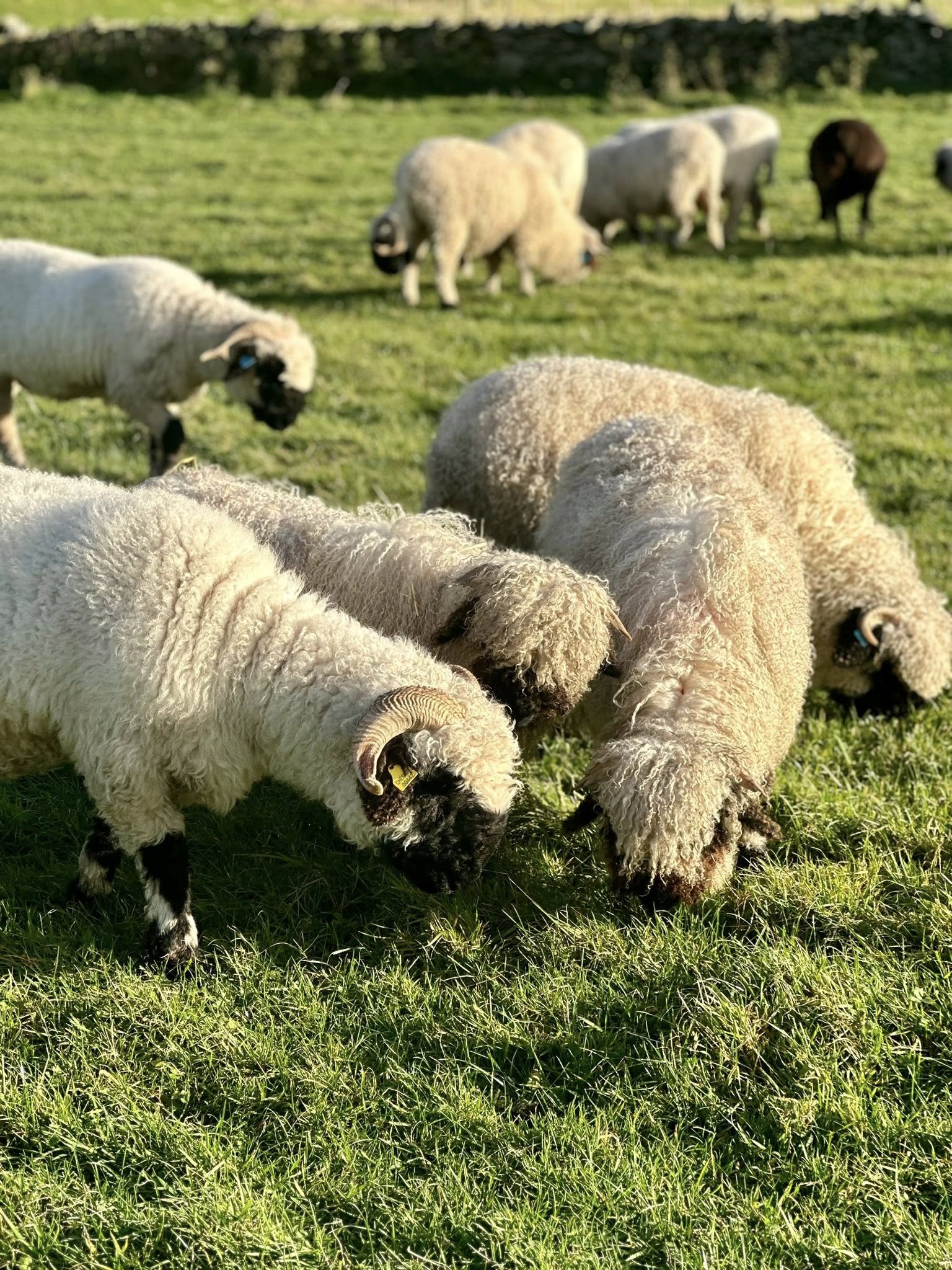
We’ve been on the road this Summer, from The Great British Farmfest to Royal Bath & West, Three Counties, Cumberland, Great Yorkshire and of course Blacknose Beauties! We’ve met lots of lovely people interested in this beautiful breed and so, here are our answers to some questions posed to us on our travels this summer. These are just my thoughts and what I have learned since starting this journey, it won’t be the same for everyone and there are many many more people out there with much more experience of owning Valais and/or working with the breed, and I am in no way qualified to give expert advice.
Do you have valais?
I do indeed, my valais are the inspiration behind the brockholes valais merchandise range ❤️
How much space do they need?
The Valais Blacknose Society Care Guide is a brilliant reference point for how to care for your Valais, including space and grazing access. We have 120 acres on the farm but when I first got the 4 girls I imagined them living happily in a little paddock. I soon learned that even just 4 young but chunky sheep on a small area results in churned ground! Ive also watched them over the years and they absolutely love to roam and explore, we are currently pretty lucky as there are 3 nice pasture fields (approximately 20 acres) that connect together and also link to the barn, so this is usually where they live.
Do they need a Barn?
I personally would say there is a need for some sort of larger, solid, draught and leak free building, in addition to field shelters. I know some people choose to keep their Valais indoors throughout winter - we haven’t had to do that so far, they do have free access to come and go from the barn throughout winter, but we do keep them inside when severe weather is forecast (storms, gales, heavy snow, extreme cold etc) so I personally think the ability to house them if you need to is essential.
Whist a draught-free building is essential for lambing, we have successfully lambed in our stables aswell as the barn.
We also bring them into the barn for footbathing as that is where our solid floors are to let them dry post bathing, and for vaccinations and drenches purely as that is where they can be contained easily.
What else do you think is essential?
A good farm vet who knows sheep is a must, a well stocked food supplier (who also stocks wormers , vaccines etc) and sheep hurdles! We started with wooden hurdles which are really good as they are heavy and sturdy, but they aren’t as mobile (with being heavier) and not as easy to keep sterile. I invested in some galvanised ones this year which are lighter and easier to move quickly and they are great for popping up little makeshift barriers and pens.
Do you show your sheep?
Me and my girls haven’t yet competed! I never really knew why but having been asked this question a lot recently, on reflection I havent shown because i am happy with how we are. The valais community is genuinely lovely and supportive, and I will at some point in time throw my woolly hat into the show ring.
How will you know which sheep to show?
I’ll be honest, 3+ years into this adventure, spectating at local, county and national shows and reading about standards I still don’t have much of a clue on that front at all - the best way to learn will be to have a go. So, for our first outing i will choose which sheep to show with me based on their temperament, character and how comfortable i think they will be with the situation❤️
Are they easy to look after?
I wouldn’t say “easy” as such, as with anything the more you put in the more you (and they!) get out! They need time, patience, dedication, commitment and you need to be willing to ask questions and learn. I have had herdwicks, icelandics and swaledales at the farm and our valais live with ryeland, southdown babydolls and a group of texel crosses - all lovely animals, and whilst I’ve found the Valais do need extra care and attention, for me the valais are the best to work with.
You definitely work hard for the sheep to make sure they are happy and healthy, but I personally find it a commitment to a life choice, not hard work or a chore.
I see, check and interact with each one daily. Ultimately I believe knowing my sheep as individuals is key to me knowing if anything is wrong with them.
What do they eat?
Ours love I’anson Gold Blend Flakey. They also need access to grass and/or hay - we are lucky enough to get a good supply of hay off our fields that more or less takes us over the winter months when grazing isn’t available. They also have access to mineral licks - I’ve found the Tubby Tubs for feet and for orf to be really good, and the Mole Valley feet and fertility also seems to help with their feet. Those are the basics for our little flock, then you are in to personal preference. Some like fruit and veg, some absolutely do not. One of our older girls loves carrots, whereas another who generally eats everything and anything (she once snaffled a spilt can of doctor pepper) looks at you in total disgust. Everyone will bowl you over for a Rich Tea biscuit, a couple of them like Ginger Nuts and we are currently testing Digestives with a mixed reception 🙃🙈
What treatment do they need?
They are sheared twice a year and get a stripe of pink clik down their spine, shoulders and back legs/bum area. The pink clik is long acting and keeps nasty flies away. So far, we haven’t experienced fly strike (frantically touches wood) but we keep treatment supplies (such as maggot oil) in stock just incase.
They are dipped once a year - this isn’t pleasant to watch and they (nor I) absolutely do not enjoy dipping day but it is essential in that it helps keep nasty skin conditions and parasites away. It also helps their feet and seems to do good things to their wool.
We footbath regularly (frequency determined by weather/surface conditions).
Each lamb has 2 heptavac p injections after birth, and all sheep have a booster every year.
Each sheep is vaccinated against the bluetongue virus with bultavo 3, we do this annually ahead of midge season.
We vitamin drench with Nutrimax and we have a b12/selenium drench instock just incase.
We don’t treat with a wormer or fluke treatments en mass or at a set time, we take monthly poo samples and this determines if and how they are treated.
We’re also experimenting with garlic powder and apple cider vinegar as natural parasite preventatives.
This might sound a lot but remember these arent daily activities - it’s mainly about having a calendar, planning in advance, making sure you have supplies and effective time management.
Do you make money off them?
No 😆, it might sound easy but even if you do sell your sheep the amount of care and work that goes in to successfully raising the sheep often negates the price they are sold at. The record breaking sales that make the news have years of research, dedication and hard work behind them - you can’t just get a girl sheep, introduce her to a boy sheep and magically raise thousands of pounds selling her lambs.
What do you do with the Fleeces?
We use some fleece for gardening, and we have trialled it as a base for winter beds - we were a little sceptical incase it made the beds wet but it seemed to do a good job of padding the base when combined with larger flakes sawdust and straw. We’ll try it out again this winter for sure.
Some fleece we sell in the shop as bird nesting material too, which is very popular.
I have found an outlet now who will process the raw fleeces into wool balls for us, so that will be coming soon.
I would like to learn how to make those vegan sheepskin rugs and cushions ❤️
How and why do you tame them?
Aside from the enjoyment i get from their company, I’ve found keeping them relatively tame makes the more challenging times less stressful for both them and me. If we need to handle them if they’ve got a poorly foot for example, or to vaccinate, they are used to people and to being handled. It is also usually me who looks after them day to day, therefore it is important to me that they can be treated quickly and with as little fuss as possible should the need arise - the more comfortable they are with humans, the more success i have treating them single handedly.
I get them comfortable with people by spending time, and by being persistent and patient. Biscuit bribery also works.
Eventhough they were all raised and treated the same, our flock is a little mixed bag of varying levels of tameness. Some are super friendly, in your face, demanding attention every time they see you. Others are less interested and some are downright wary. It does change over time - our little Dough for example was never a super cuddly lamb, it’s taken around 2 years for him to relax enough to tolerate a chin scratch and a head bop and to be comfortable approaching you. We have 3 lambs from 2025 - Mittens, Miley and Marmaduke - who are the same as little Dough, you can see Marmaduke softening slowly already. From the same group of lambs we have Margarita and Mason who will basically get on your knee for snuggles, Mallow who has no appreciation of personal space, Maple who we believe whittles the ends of her horns to spikes overnight and likes to run into the back of your knees, Mojito who just launches himself on you and a bunch of pushy edgy little boys who would give the T Birds a run for their money.
What’s been your biggest challenge with valais?
Three things; their feet, worms and keeping weight on in winter!
Feet - This one is pretty breed specific for the valais tor us. The wet howgill weather is not our friend, bluespray definitely is! In our early days it was a constant battle. We footbath with formalin and we have found Footvax invaluable. The formalin has been a little drying for some of the sheep, so it’s been a balancing act. We have also seen good results with draxin (following discussion with our wonderful farm vet of course).
Worms - we experienced quite high worm burdens in our first year, and in 2025 the awful barber pole reared its horrible head and we lost 2 of our much loved flock members very quickly. Again, in consultation and conjunction with our brilliant vets we have a program that, touch wood, appears to be working. We faecal sample monthly (more often in high risk periods), and i am now trained to carry out the faecal samples myself - this makes sense financially but primarily for me it means we can have instant results incase there is a sheep we are particularly worried about. We have found our worms resistant to ivermectin, but have had success with zolvyx so far 🤞🏼
Weight - As part of the journey, I’ve learned the hard way that a good body condition is pivotal in fighting illnesses (such as heavy worm burdens), and my personal experience so far has been that Valais are more difficult to keep in optimum condition over winter than our other breeds of sheep. We nailed the regime over the winter of 25/26 and came into spring with a squad of tip top chunky-bummed Valais - their texel and hampshire field buddies however had REALLY benefited from the winter supplemental feeding, resembling barrels, and are now on a ln enforced diet 🙈
What is the Worst Part?
I think anyone with animals would say the same, losing anyone is the most difficult part, and you spend a lot of time wondering if you could have done any better, and naturally blaming yourself.
I remember when we first ventured into sheep keeping and were told “Sheep will find any way they can to die”. Thankfully we have so far (frantically touches as much wood as possible) been very lucky but we have had to say goodbye too early, which has been devastating.
Do you hand rear your lambs?
Our little group of bottle reared Wethers joined our flock in 2024 at around a week old, and lived in our kitchen before slowly transitioning to the main sheep field. We don’t intentionally hand rear lambs born here, but we will intervene when necessary. We have been lucky with our valais and all the Mums have been spot on, been attentive and had enough milk. We have found valais lambs a bit slower to get the hang of it than other breeds (it’s not uncommon for them to be trying to drink from mums front “armpit”) in which case we guide them to the right area, and monitor how much they are drinking/how often (the belly balloon test is really useful). Sometimes we will top up the lambs before bed with a good glug of milk replacer if in any doubt.
Before our next lambing season I am going to invest in a colostrum milker/pump, just to give that extra confidence that they are getting what they need.
We haven’t had to fully hand rear any valais, but we have had very good success with our 2 non-Valais hand rears, Dipsy and Dinky. Dipsy is a Herdwick who was born with some neurological issues, and her mum rejected her from day one. As mum got more aggressive we took the decision to remove Dipsy, she was tiny, not quite with it, and we didn’t hold out much hope. Dipsy wouldn’t drink much at all so our approach was to let her have her little bits but more often. We also found dipping the teat in honey worked a trick. Dipsy is now over 2 years old, and is fully integrated into the rest of the flock despite living in our kitchen for around 4 months! Dinky is a Suffolk Texel cross who came to us from a neighbour farm when her mum died, having had full colostrum from mum she was in a much better position than dipsy, she was also a proper chunk with an incredible set of lungs and the biggest ears we had ever seen! Dinky is also fully integrated into the flock now after living in our kitchen for around 2 weeks.
Are your sheep registered pedigrees?
Yes. All our girls are pedigree Valais registered with the Valais Blacknose Society. Our first Ram moved to a new home in 2025, all our current boys are wethers - we have registered them as birth notifed with the society and they have a certificate of birth ❤️
Do you breed your sheep?
We started with 4 young ewes in 2023, these were joined by 3 older ewes (2 of whom were in lamb) and a ram at the end of the year. In 2024, four wether “bottle boys” came to us aged around 1 week old, at the same time as our first farm-born lambs arrived, that same year our original girls welcomed their lambs (not 100% planned, but all went extremely well!). 4 Spittis came to join the family that same year. We then welcomed a group of 10 mums, who had 14 lambs between them in January 25. Our ram and the group of Mums moved on to a new home at the end of the year. Following some personal health challenges in 2025 I chose not to add more lambs to the mix this year , but we did welcome a very special lamb and her mum in March and I am now plotting to add a boyfriend for a select couple of our girls who will be amazing mums ❤️
Do you sell your sheep?
I intended to, but i have never been able to part with them which is why the little family stands at over 30 who are here to stay. The only 2 other Brockholes valais out there currently are living with our shearer’s (AKA our oracle of information) mum, as she had always loved the breed ❤️
Are they really £2000 each?
The sheep we have bought in the past varied in price, our beautiful wether lambs were £250 each, our girls varied from £800 to £1600 each.
How do i choose a valais sheep?
I have purchased from a few different breeders, and whilst i do love all my sheep, i do see a difference between them. I am no expert but I will happily recommend the breeder who i would go back to every time, if you pop me an email :)
I’ve read that Shearing is cruel though?
Thank you PETA for spewing this misinformation. It couldn’t be further from the truth. Shearing is an essential part of being a responsible sheep carer. It prevents overheating, keeps them hygienic and clean which discourages flies, means lambs can get to their milk and as they are cleaner it means mum is at less risk of passing nasty germs to her little ones. Also a sheep carries a lot of weight in their fleece (3kg for a valais at time of shearing), and this doesn’t stop growing. Without shearing it becomes matted, dirty and super heavy - making it difficult for the sheep to move around.
I have only ever met good shearers who have done a fabulous job shearing my woollies with very little stress for the sheep.
The argument that sheep have been historically bred by humans for so long that they now need shearing, even if true, is irrelevant, they are here as they are, and in their current state they need regular shearing, it would cruel not to.
Where are their eyes 🙄?
Yes, thank you Jeremy, enough said.
Do you have any BAAAAA-rgains?
Just 🙄 🙈😆
Project Rhino Fundraiser
-
Valais Blacknoses Saving Big Noses Magnet: Keeps a Ranger on the ground for 4 hours
Regular price £3.32 GBPRegular price -
Valais Blacknoses Saving Big Noses: Christmas Card in aid of Project Rhino
Regular price £3.32 GBPRegular price


Meet the Flockers